
Can Online Scoliosis Training Work When Local Therapy Has Failed?
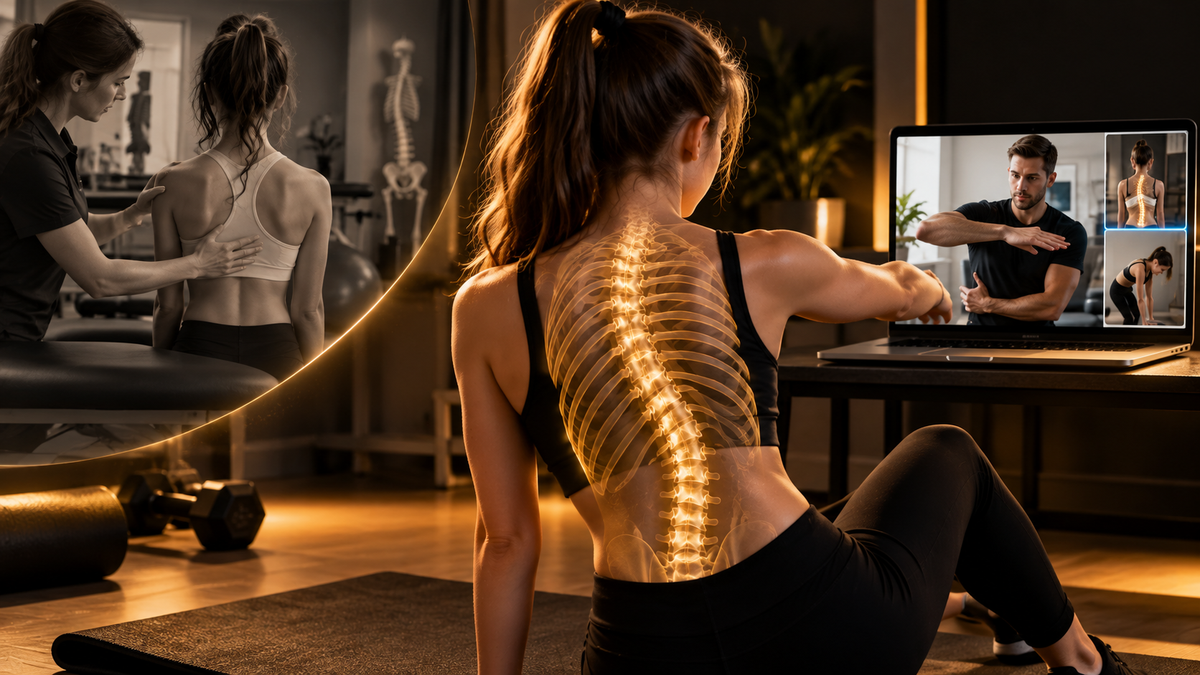
Yes — online scoliosis training can be a reasonable next step when previous local therapy has produced limited results, but only if the online program is genuinely individualized.
The fact that treatment happens through a screen is not the most important question.
The more important questions are:
- Was the scoliosis properly assessed?
- Were the exercises selected for that individual's curve and physical presentation?
- Were muscular asymmetries actually evaluated?
- Was spinal rotation considered?
- Was the program progressed over time?
- Was the teenager reassessed as they grew and changed?
If those pieces were missing from previous treatment, changing location alone will not solve the problem.
Changing the system might.
Quick answer: Online scoliosis training can work well for selected people when it includes live assessment, review of previous treatment and imaging, individualized exercise selection, clear video instruction, progressive programming, regular reassessment, and appropriate coordination with medical care. It should not be another generic exercise library delivered through the internet.
Medical note: SpineX™ provides fitness-based assessment and personalized exercise programming. It does not replace diagnosis, orthopedic monitoring, prescribed bracing, imaging, or surgical consultation when those are medically indicated.

Table of Contents
- First: What Does “Local Therapy Failed” Actually Mean?
- Is Online Scoliosis Training Automatically Less Effective?
- What Can Actually Be Assessed Online?
- How X-Rays and Previous Treatment Are Reviewed
- Who Is a Good Candidate for Online SpineX™ Training?
- Who May Need Medical Review First?
- How SpineX™ Personalizes Online Training
- How an Online Program Is Progressed
- Why Reassessment Matters
- What Parents Need to Do at Home
- Advantages of Online Scoliosis Training
- What Online Training Cannot Do
- What Happens During the Surgery-Avoidance Assessment?
- Frequently Asked Questions
First: What Does “Local Therapy Failed” Actually Mean?
Before changing programs, define what “failed” means.
Families can use that word for very different situations.
For example:
- The Cobb angle increased despite months of treatment
- The curve remained stable, but the family expected reduction
- The rib hump still looks prominent
- Shoulder asymmetry remains visible
- The teenager does not feel stronger
- The exercises have never changed
- The program feels generic
- No one has assessed right-to-left strength differences
- No one has reassessed the teenager after a growth spurt
- The family does not understand what the current treatment is trying to achieve
These are not the same problem.
For example, a brace may have been prescribed primarily to reduce progression risk during growth.
It should not automatically be considered a failure because it did not straighten the spine.
Likewise, an exercise program may improve strength or physical control without producing a large Cobb-angle change.
But there is also another possibility:
The exercise strategy may simply not have been individualized enough.
We explore that broader question in Why Isn’t My Child’s Scoliosis Treatment Working?.
This article focuses on the next question:
If the previous approach produced limited results, can personalized online training offer something meaningfully different?
Is Online Scoliosis Training Automatically Less Effective?
No.
Being physically inside a clinic does not automatically make an exercise program individualized.
And being online does not automatically make it generic.
The quality of the program depends on what is actually assessed and how the training is built.
A local program can still be generic.
An online program can still be highly individualized.
The important variables include:
- Assessment quality
- Exercise selection
- Individualization
- Exercise technique
- Progressive resistance
- Adherence
- Reassessment
- Communication
This is the foundation of the SpineX™ model.
We do not try to recreate a traditional clinic appointment through Zoom.
We use the online format specifically to observe the person in their real environment, review how they move, assess the equipment they actually have, and build a program they can perform consistently at home or in their own gym.
What Can Actually Be Assessed Online?
A live video assessment cannot replace an X-ray.
But an X-ray also cannot answer every physical-training question.
During a SpineX™ live assessment, we can evaluate physical presentation such as:
- Natural standing posture
- Shoulder asymmetry
- Pelvic position
- Trunk shift
- Forward-bending presentation
- Visible rib prominence
- Trunk rotation
- Side bending
- Movement control
- Right-to-left differences
- Visible muscular development
- Exercise technique
- Current strength capacity
These findings help answer a different question from the X-ray.
The X-ray helps describe the structural curve.
The live assessment helps us understand how the person actually moves and trains.
That distinction is especially important when considering unilateral scoliosis training.
You cannot safely assume which side needs more strengthening simply from the direction of the curve.
The individual must be assessed first.

How X-Rays and Previous Treatment Are Reviewed
Online training does not mean ignoring medical information.
When relevant information is available, families may provide:
- Recent X-ray images
- Radiology reports
- Documented Cobb angles
- Previous progression history
- Brace information
- Existing exercise plans
- Previous therapy exercises
- Videos showing current exercise technique
The goal is not for SpineX™ to replace the radiologist or orthopedic specialist.
The goal is to understand the context before creating another exercise plan.
If a teenager has already spent six months performing a particular exercise without meaningful progression in difficulty, there is little value in simply sending the same exercise again.
Previous treatment should inform the next program.
It should not be ignored.
Who Is a Good Candidate for Online SpineX™ Training?
Online training can be particularly useful when the person:
- Already has a confirmed scoliosis diagnosis
- Has access to their relevant medical information
- Can safely perform exercise
- Can follow video instructions
- Has a parent available to assist when appropriate
- Can record exercise videos for technique review
- Can communicate consistently
- Is willing to follow a progressive program rather than search for a quick fix
It may also be useful for families who simply do not have access to highly individualized scoliosis-focused strength training locally.
Geography should not automatically determine the quality of a person's training plan.
SpineX™ has been designed around that problem from the beginning: personalized scoliosis training that can be delivered wherever the client lives.
Who May Need Medical Review First?
Online training is not automatically appropriate for everyone.
Medical review may need to come first when there are concerns such as:
- New neurological symptoms
- Substantial unexplained weakness
- Numbness or altered sensation
- Bowel or bladder changes
- Significant breathing concerns
- Severe or rapidly worsening pain
- Recent major trauma
- Rapidly changing symptoms
- Unclear diagnosis
A teenager with a severe or progressing curve may also need ongoing orthopedic or surgical discussion regardless of whether they participate in exercise.
The purpose of SpineX™ is not to tell families to abandon appropriate medical care.
It is to provide a more individualized physical-training strategy alongside that care when appropriate.
How SpineX™ Personalizes Online Training
This is where online SpineX™ Training differs from downloading a list called “10 Best Scoliosis Exercises.”
There is no universal exercise prescription for every scoliosis pattern.
The program is built around the person's assessment.
The SpineX™ 3D Scoliosis Method combines:
- Individualized assessment
- 3D de-rotation principles
- Unilateral strength training where appropriate
- Progressive exercise programming
The conceptual sequence is:
Decompress → De-rotate → Strengthen → Progress
That may include carefully selected movements such as:
- Unilateral lat pulldown
- Unilateral seated lat row
- Unilateral leg extension
- Unilateral hamstring curl
- Side plank
- Elbow plank
- Dead bug
But those exercises are not automatically appropriate for every person.
The important part is not the exercise name.
It is:
Who performs it, which side performs it, why it was selected, how it is executed, and how it is progressed.
How Is an Online Scoliosis Program Progressed?
A scoliosis program should not remain identical for months.
The body adapts.
The teenager grows.
Strength improves.
Exercises that were difficult become easy.
Technique changes.
The program therefore needs progression.
Depending on the individual, progression may involve:
- Increasing resistance
- Increasing repetitions
- Increasing sets
- Improving movement control
- Changing the exercise variation
- Changing the range of motion
- Changing which side receives additional work
- Introducing a more demanding progression
This is one reason SpineX™ does not treat exercise programming as a PDF that is handed over once and forgotten.

Why Reassessment Matters
A personalized program stops being truly personalized if nobody checks whether the person has changed.
This matters even more for teenagers.
A teenager can grow substantially within several months.
Their:
- Height
- Body proportions
- Strength
- Movement control
- Visible posture
- Rotation
- Muscular development
can all change.
That is why SpineX™ uses reassessment to determine what should stay, what should progress, and what should change.
The sequence becomes:
Assess → Train → Reassess → Progress
Without reassessment, the program eventually becomes another generic routine.
What Do Parents Need to Do at Home?
For younger clients, parents play an important role.
They do not need to become scoliosis specialists.
But they can help with:
- Recording assessment videos
- Recording exercise technique
- Helping position the camera
- Tracking resistance and repetitions
- Maintaining communication
- Helping the teenager stay consistent
- Providing updated medical information when relevant
This can actually be an advantage of the online model.
The family becomes involved in understanding what the teenager is doing rather than simply dropping them at a clinic and waiting outside.
What Are the Advantages of Online Scoliosis Training?
For an appropriate client, online training can offer several practical advantages.
1. Access is not limited by geography
The family does not need a SpineX™ location nearby.
2. Training happens in the real environment
We can see the actual home or gym equipment the person will use.
3. Technique can be recorded
Exercise videos can be reviewed instead of relying only on memory from one appointment.
4. Programs can be updated remotely
The plan can evolve without requiring repeated travel.
5. Parents can understand the strategy
The process becomes more transparent.
6. Previous local treatment can still be incorporated
Starting SpineX™ does not require pretending nothing useful happened before.
The previous plan provides information about what has already been tried.
What Online Scoliosis Training Cannot Do
There are also clear limits.
An online fitness-based assessment cannot:
- Diagnose scoliosis
- Measure a Cobb angle without appropriate imaging
- Replace a radiologist
- Prescribe or modify a brace
- Replace orthopedic monitoring
- Provide surgical clearance
- Guarantee that a curve will decrease
- Guarantee that surgery will be avoided
Those limitations do not make online training useless.
They define what the service is actually designed to do.
SpineX™ focuses on the physical qualities that can be assessed and trained:
- Strength
- Movement quality
- Muscular asymmetry
- Postural control
- 3D movement
- Exercise capacity
- Progressive training
What Happens During the SpineX Surgery-Avoidance Assessment?
If previous local treatment has produced limited results, the first SpineX™ step is not buying another random program.
It is understanding what has already happened.
The SpineX Surgery-Avoidance Assessment is a live one-on-one video call.
Before or during the assessment, relevant information may include:
- Age and growth status
- Available X-rays
- Cobb-angle history
- Previous progression
- Brace use
- Previous therapy
- Current exercises
- Sport participation
- Available equipment
During the call, physical assessment may include:
- Natural standing posture
- Forward bending
- Rotation
- Side bending
- Shoulder position
- Pelvic position
- Visible rib prominence
- Movement symmetry
- Muscular development
- Current physical capacity
The purpose is to answer one critical question:
Is personalized SpineX™ Training an appropriate next step for this person?
If it is, the training plan can then be built around what was actually observed rather than around a generic scoliosis label.
Already Tried Local Therapy?
If months of treatment have produced limited results, repeating the same strategy indefinitely may not be the best next move.
That does not mean every previous treatment was useless.
It means it may be time to reassess the curve presentation, muscular asymmetries, rotation, movement, current strength, program progression, and what has already been attempted.
The SpineX Surgery-Avoidance Assessment allows that review to happen live from your home before you commit to another training program.
 Frequently Asked Questions
1. Can scoliosis really be trained online?
Yes, selected physical-training components of scoliosis management can be delivered online when the program includes appropriate assessment, clear exercise instruction, video feedback, progressive programming, and regular reassessment. Online training does not replace diagnosis, imaging, orthopedic monitoring, or prescribed bracing. Its role is to provide individualized fitness-based training around the person's actual movement and strength presentation.
2. Is online scoliosis training just a set of videos?
It should not be. A prerecorded exercise library is very different from personalized online coaching. SpineX™ begins with an individualized assessment and uses the findings to determine exercise selection, unilateral strategy where appropriate, 3D de-rotation work, resistance, volume, progression, and reassessment.
3. What if physical therapy did not work for my child?
First define what “did not work” means. The curve may have progressed, visible asymmetry may remain, strength may not have improved, or the exercises may have stopped progressing. Previous limited results do not automatically mean all exercise-based options will fail. They do mean the next program should begin with reassessment rather than simply repeating another generic routine.
4. Do we need X-rays before starting online training?
SpineX™ does not diagnose scoliosis through a video call. If scoliosis has been medically diagnosed, relevant imaging and reports can provide useful structural context. Whether new imaging is medically necessary is a decision for the treating healthcare professional. The SpineX™ assessment focuses on physical presentation, movement, rotation, muscular asymmetry, strength, and training needs.
5. Can SpineX™ tell which side is weak from an X-ray?
No. A standard scoliosis X-ray shows spinal structure but cannot determine which side is functionally stronger or weaker. Strength and muscular asymmetry need to be assessed separately. This is why SpineX™ does not prescribe unilateral training purely from curve direction.
6. How do you correct exercise technique online?
Clients can perform exercises live or send recorded videos showing their technique. Camera position, range of motion, resistance, body position, control, and execution can then be reviewed. Clear demonstrations and specific corrections allow the client to repeat the exercise in the same environment where they normally train.
7. How often should an online scoliosis program change?
There is no universal schedule for every person. The plan should evolve according to strength, technique, exercise tolerance, growth, physical changes, and reassessment findings. A program that remains exactly the same despite meaningful physical progress or adolescent growth is no longer fully individualized.
8. Can online training reduce the Cobb angle?
No responsible program should guarantee Cobb-angle reduction. Some exercise research reports changes in radiographic or clinical outcomes in certain participants, but results vary. SpineX™ focuses on individualized training of movement, strength, muscular asymmetry, 3D control, posture, and physical capacity while structural progression continues to be monitored appropriately.
9. Can we continue medical care while doing SpineX™ online?
Yes. SpineX™ is designed to work alongside appropriate medical care. Families should continue prescribed orthopedic monitoring, imaging, and bracing unless the responsible healthcare professional recommends a change. Starting personalized training does not require abandoning existing medical care.
10. What is the first step if local therapy has not produced the results we expected?
Do not immediately purchase another generic exercise plan. First review what has already been tried, what outcome was expected, whether the teenager has grown or progressed, how individualized the previous exercises were, and whether strength, rotation, movement and muscular asymmetry were assessed. The SpineX Surgery-Avoidance Assessment is designed to perform that functional review and determine whether personalized online training is an appropriate next step.
Conclusion
At SpineX, we don't prescribe the same exercises for every person with scoliosis. The SpineX™ Method is a proprietary fitness-based scoliosis training system built on unilateral strength training, 3D de-rotation principles, individualized assessment, and fully personalized, progressive exercise programming. Every scoliosis is different, which is why each person's curve pattern, muscle imbalances, movement limitations, and goals require an individualized approach.
If you've made it this far, you're probably not just curious — you're looking for something that actually applies to you, or to your child, instead of another generic list that never quite fits. That's exactly what an individualized assessment is for. You don't need to guess, and you don't need to keep training blind. The SpineX Surgery-Avoidance Assessment is a live, one-on-one video call from wherever you are — no equipment, no clinic visit, just simple movement checks like bending forward and rotating side to side, so we can actually see how your body moves before recommending anything. Book your Surgery-Avoidance Assessment and finally get answers built around your spine, not a generic formula. You can also explore the SpineX™ 3D Scoliosis Method to see how a personalized program comes together once your assessment is complete.
About the Author
Kamil, founder of SpineX™
Kamil is the founder of SpineX and creator of The SpineX™ 3D Scoliosis Method — a proprietary fitness-based scoliosis training system. His methodology combines unilateral strength training, 3D de-rotation principles, individualized assessment, and fully personalized, progressive exercise programming to help people with scoliosis improve movement quality, build strength, address muscle imbalances, reduce three-dimensional spinal asymmetries, and support long-term spinal health through non-surgical management.
Through SpineX, Kamil has worked with clients worldwide, providing personalized online coaching, educational resources, and evidence-informed exercise strategies for scoliosis, kyphosis, posture, and spinal asymmetries.
Evidence and Trusted Sources
- Scoliosis Research Society — Adolescent Idiopathic Scoliosis — background on diagnosis, progression, observation, bracing and surgical management of adolescent idiopathic scoliosis.
- Cochrane Review — Therapeutic Exercise for Adolescent Idiopathic Scoliosis — systematic evidence review examining therapeutic exercise for adolescents with idiopathic scoliosis.
- SpineX — Why Isn’t My Child’s Scoliosis Treatment Working? — explains how families can review progression, treatment goals, exercise specificity, bracing and previous conservative treatment before changing direction.
This article is for educational purposes only and does not provide medical diagnosis or individualized medical advice. SpineX™ Training does not guarantee Cobb-angle reduction, structural correction, progression prevention, or surgery avoidance.