
Scoliosis & Backpacks: Does the Way My Child Carries Their Bag Actually Matter?
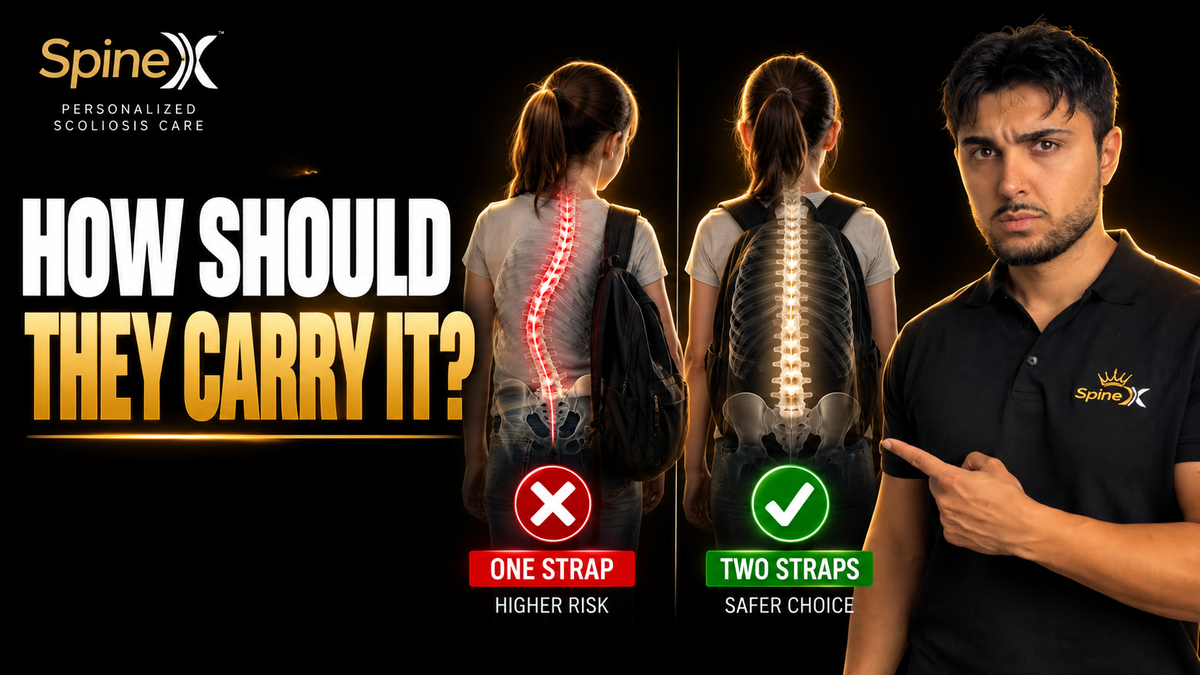
A school backpack can change how your child stands and walks while it is being carried. If it is too heavy, poorly fitted, or worn on one shoulder, it can also contribute to fatigue, shoulder pressure, and back or neck discomfort. But that is not the same as causing scoliosis or making a structural scoliosis curve progress.
That distinction matters. Parents often notice one shoulder sitting higher, a child leaning forward, or a bag hanging to one side and understandably worry that the backpack is “bending the spine.” The more useful question is not whether one ordinary school bag will create scoliosis. It is whether the bag is adding an avoidable daily load to a child who may already have spinal rotation, muscular asymmetry, a brace, pain, or reduced tolerance for carrying.
This guide explains what current evidence says, how to choose and fit a backpack, which warning signs deserve attention, and how backpack habits fit into a broader plan for a child with scoliosis.
Table of Contents
- The short answer
- Can a heavy backpack cause scoliosis?
- What Does a Backpack Actually Change in the Body?
- How heavy should a child’s backpack be?
- Does carrying it on one shoulder matter?
- How to fit and pack a backpack
- Special considerations for children with scoliosis
- Backpacks and scoliosis braces
- Warning signs parents should not ignore
- A two-minute weekly backpack check
- Frequently asked questions
The Short Answer: The Way Your Child Carries a Backpack Matters, but Not for the Reason Many Parents Fear
A backpack matters because load, fit, carrying time, and the way weight is distributed can affect comfort and temporary posture. A child may lean the trunk forward, extend the head, raise one shoulder, shorten their stride, or become tired sooner when the load is excessive. These are adaptations to an external load.
However, the Scoliosis Research Society states that a heavy backpack does not worsen scoliosis. Adolescent idiopathic scoliosis is not understood to be caused by ordinary backpack use, poor sitting posture, or a child occasionally carrying books on one side.
That does not make backpack habits irrelevant. A poorly managed bag can still provoke discomfort, make an existing asymmetry look more obvious while the bag is on, or reduce a child’s willingness to walk and stay active. For a child with scoliosis, the goal is sensible load management—not fear, blame, or a false promise that changing the bag will correct the curve.

Can a Heavy Backpack Cause Scoliosis?
There is no good evidence that school backpacks cause adolescent idiopathic scoliosis. The word idiopathic means that a single cause has not been identified. Genetics, growth, skeletal maturity, curve characteristics, and other biological factors are more relevant to medical discussions about why scoliosis develops or progresses than the brand of bag a child carries.
A heavy backpack can create a visible lean or change posture during carrying. Once the bag is removed, that external load is gone. A structural scoliosis curve is different: it involves a three-dimensional spinal presentation that may include lateral curvature and vertebral rotation. If you want a clearer explanation of that distinction, read our guide to Cobb angle versus spinal rotation.
Parents should also avoid self-blame. A child’s scoliosis was not caused because a parent bought the wrong backpack, because the child carried a laptop, or because the bag was worn over one shoulder for a semester. Better backpack habits can improve comfort and reduce unnecessary strain, but they are not a treatment for the spinal curve.
What about curve progression?
Progression risk is assessed medically using factors such as the child’s age, growth remaining, curve magnitude, curve pattern, and change across comparable X-rays. A bag may influence how a child looks or feels for part of the day, but it is not a substitute explanation for a changing Cobb angle. Parents concerned about growth should review what actually drives scoliosis progression during puberty and keep the recommended orthopedic follow-up schedule.
What Does a Backpack Actually Change in the Body?
The body must keep its combined center of mass over the feet. When weight is placed behind the trunk, a child may lean forward or adjust the head, pelvis, and steps to stay balanced. The heavier the bag and the longer it is carried, the more noticeable those adaptations may become.
A systematic review of backpack load and posture in schoolchildren found that studies often report postural changes with heavier loads, while also noting limited evidence quality, small samples, and no universally proven safe cutoff. A separate critical review of school backpack loads reported biomechanical and physiological adaptations, fatigue, discomfort, and pressure-related symptoms, while emphasizing important limitations in the research.
These studies support practical caution, but they do not prove that a backpack creates a permanent deformity. Posture under load is not the same as posture without the load, and neither is identical to the full three-dimensional structure of scoliosis.
Temporary posture versus a fixed change
If your child leans forward only while carrying the bag, the first step is to reduce the weight, improve the fit, and observe them again without the bag. If a shoulder difference, rib prominence, trunk shift, or uneven waist remains without the backpack, it deserves separate attention rather than being blamed on the bag.
This is also why a flat X-ray and a quick glance at standing posture cannot explain everything. Our article on why scoliosis X-rays miss movement and muscular asymmetry explains how structure, rotation, pelvic position, and movement need to be considered as related but distinct pieces.

How Heavy Should a Child’s Backpack Be?
Many pediatric and school-health resources use a practical upper limit of approximately 10% to 15% of body weight. The American Academy of Pediatrics’ parent resource, HealthyChildren.org, advises that a backpack should not exceed 15% of a child’s body weight.
This is a useful screening rule, not a guarantee that every child will be comfortable at exactly the same percentage. A 35 kg child carrying 3.5 kg is at 10%; carrying 5.25 kg is at 15%. But symptoms, walking distance, stairs, fatigue, brace use, and the child’s individual capacity still matter. Some children may need a lighter bag even if it falls below a published limit.
Use the scale, then use your eyes
Weigh the child with and without the packed bag, or place the loaded bag on a household scale. Then watch the child walk for 20 to 30 seconds. A bag is functionally too demanding if the child must lean markedly forward, struggles to put it on, reports numbness or pain, frequently adjusts the straps, or cannot walk normally.
Also consider duration. Carrying four kilograms for two minutes from a car to a classroom is not the same exposure as carrying it for 30 minutes, up stairs, and between multiple buildings. The practical target is the lightest load that meets the school day’s needs.
Does Carrying a Backpack on One Shoulder Matter?
Using one shoulder creates an asymmetric external load. The child may elevate one shoulder, side-bend the trunk, grip the strap, or shift the pelvis to keep the bag from slipping. That can increase local fatigue and make an existing postural asymmetry more visible while the bag is being carried.
It still does not mean the one-shoulder habit has caused the scoliosis curve. The concern is repeated comfort and load management. Two shoulder straps generally distribute weight more evenly and keep the bag closer to the body. A chest strap can limit side-to-side movement; a waist strap can transfer part of the load toward the pelvis when it is fitted correctly.
For a child with scoliosis, do not create a universal rule such as “always carry it on the higher shoulder” or “use the opposite side to correct the curve.” Shoulder height does not reveal the complete curve pattern, spinal rotation, pelvic position, or muscular strategy. Using a bag as a homemade corrective device is not part of individualized scoliosis management.

How to Fit and Pack a School Backpack Properly
A good backpack should fit the child who is wearing it, not simply hold every item the school might require. The following checklist gives parents a clear starting point.
Choose the right size
- Select a child-sized bag rather than an oversized adult backpack.
- The bag should sit close to the back and should not hang far below the waist.
- Look for two wide, padded, adjustable shoulder straps.
- Prefer several compartments so items cannot collect in one heavy corner.
- Consider chest and waist straps if the child has a longer walk or carries more equipment.
Pack weight close to the body
Place dense items—such as textbooks, tablets, and laptops—in the compartment closest to the child’s back. Distribute smaller items evenly instead of loading one outer pocket. Remove sports kit, water bottles, books, chargers, and stationery that are not needed that day.
Adjust both straps every time
The straps should be similar in length and snug enough that the bag does not bounce or hang away from the body. They should not be so tight that they create pressure, tingling, or difficulty moving the shoulders. Teach your child to lift the bag from a stable surface, use both straps, and avoid twisting while swinging a heavy bag onto one shoulder.
Reduce the load at the source
Good backpack technique cannot compensate for carrying unnecessary weight. Ask the school about lockers, duplicate textbooks, digital resources, classroom storage, or whether large water bottles and sports equipment can be stored separately. A rolling bag can be helpful for some children if the school permits it and the route does not involve crowded stairs.
Special Considerations for a Child Who Already Has Scoliosis
A child with scoliosis should not automatically be treated as fragile. Many children and teenagers with scoliosis attend school, walk, train, and play sports normally. As discussed in our guide to sports participation for teens with scoliosis, activity decisions should consider the individual’s symptoms, medical restrictions, movement quality, fatigue, and goals—not the diagnosis alone.
At the same time, the same backpack can feel very different to two children. One may tolerate it without a problem. Another may already have a rib prominence, trunk shift, brace pressure, reduced endurance, or pain aggravated by the school commute. The decision should therefore be based on the child’s actual response.
Do not infer corrective sides from the curve label
It is tempting to look at an X-ray and decide that one strap should be tightened more, one shoulder should carry more, or one side needs extra load. That shortcut is not reliable. Concavity and convexity do not automatically tell us which muscles are tight, weak, shortened, lengthened, overactive, or underactive.
Within the SpineX™ Method, the child’s posture, visible rotation, pelvic alignment, muscular asymmetry, movement quality, symptoms, training history, and medical context are assessed together. Only then can personalized online scoliosis training use unilateral strength training, 3D de-rotation principles, and progressive exercise programming in a way that matches that child. Our guide on when to consider an individualized scoliosis assessment for a teen explains when this deeper review may be useful.

What If My Child Wears a Scoliosis Brace?
A brace changes the interface between the child and the backpack. Shoulder straps, the lower edge of the bag, or a hard object inside the bag may press against the brace and create rubbing, heat, skin irritation, or localized discomfort. The bag may also sit farther from the body than it does without the brace.
Start by following the orthotist’s and medical team’s instructions. Do not alter the brace, add padding underneath it, or change prescribed brace hours based on a blog. Test the packed backpack while the child is wearing the brace, inspect the skin after the school journey, and report persistent redness, skin breakdown, numbness, or increasing pain to the appropriate clinician or orthotist.
Practical options can include lowering the backpack weight, adjusting strap width and length, using school storage, carrying fewer items, or changing bag style. The best choice depends on the brace design, school environment, and child’s tolerance. Bracing decisions themselves remain medical decisions.
Warning Signs Parents Should Not Ignore
Occasional tiredness after a long school day is different from persistent or worsening symptoms. Arrange an appropriate medical evaluation if your child develops continuing back pain, pain that wakes them at night, weakness, numbness, tingling, changes in walking, unexplained fever, bowel or bladder changes, major trauma, breathing difficulty, or rapidly worsening symptoms.
Also seek review if you notice a shoulder or hip difference, rib prominence, trunk shift, or uneven waist that remains when the child is standing without the backpack. A bag may reveal an asymmetry because you are watching more closely, but it should not be assumed to explain it.
If scoliosis is already diagnosed, keep scheduled clinical reviews and imaging. A backpack check can solve a backpack problem; it cannot measure a Cobb angle, assess skeletal maturity, decide whether a brace is needed, or replace an orthopedic opinion.
A Two-Minute Weekly Backpack Check for Parents
- Empty it. Remove old papers, duplicate stationery, unused books, and equipment from previous days.
- Pack it. Put the heaviest items closest to the back and balance smaller items between compartments.
- Weigh it. Use 10% to 15% of body weight as a practical screening range, while treating symptoms and walking tolerance as equally important.
- Fit it. Adjust both straps, then use the chest or waist strap if available and comfortable.
- Watch the walk. Look for marked forward lean, uneven shoulder elevation, altered steps, bag sway, or repeated strap adjustment.
- Ask one direct question. “Does anything hurt, feel numb, rub, or make you unusually tired?”
This routine reduces avoidable daily strain without turning the backpack into the explanation for every postural difference. It also gives the child a simple habit they can manage independently as they get older.

Practical Takeaways
- A school backpack does not cause adolescent idiopathic scoliosis and is not established as a driver of curve progression.
- A heavy or poorly fitted bag can change posture while it is worn and may contribute to fatigue or discomfort.
- Use two straps, keep the load close to the body, and aim for the lightest practical school-day load.
- The commonly used 10% to 15% guideline is a screening tool, not a perfect safety threshold for every child.
- Do not use uneven straps or one-sided carrying as a homemade scoliosis correction strategy.
- Persistent asymmetry without the bag, worsening pain, neurologic symptoms, or brace-related skin problems need appropriate professional review.
Article Conclusion
At SpineX, we don't prescribe the same exercises for every person with scoliosis. The SpineX™ Method is a proprietary fitness-based scoliosis training system built on unilateral strength training, 3D de-rotation principles, individualized assessment, and fully personalized, progressive exercise programming. Every scoliosis is different, which is why each person's curve pattern, muscle imbalances, movement limitations, and goals require an individualized approach.
About the Author
Kamil is the founder of SpineX and creator of The SpineX™ 3D Scoliosis Method —a proprietary fitness-based scoliosis training system. His methodology combines unilateral strength training, 3D de-rotation principles, individualized assessment, and fully personalized, progressive exercise programming to help people with scoliosis improve movement quality, build strength, address muscle imbalances, reduce three-dimensional spinal asymmetries, and support long-term spinal health through non-surgical management.
Through SpineX, Kamil has worked with clients worldwide, providing personalized online coaching, educational resources, and evidence-informed exercise strategies for scoliosis, kyphosis, posture, and spinal asymmetries.
Frequently Asked Questions
1. Can a heavy backpack make my child’s scoliosis curve worse?
A heavy backpack can make your child lean, change their head or shoulder position, and feel more tired while carrying it. That temporary response is not the same as structural curve progression. The Scoliosis Research Society says that heavy backpacks do not worsen scoliosis. Progression is evaluated through medical follow-up, comparable X-rays, growth status, curve size, and other individual factors. Reduce an uncomfortable load, but do not assume that a school bag explains a changing Cobb angle or replace a scheduled orthopedic review with backpack adjustments.
2. What percentage of body weight is safe for a school backpack?
A commonly used practical recommendation is to keep the packed backpack below approximately 10% to 15% of the child’s body weight, and the American Academy of Pediatrics advises no more than 15%. Evidence has not established one perfect threshold for every child. Walking distance, stairs, fatigue, brace use, symptoms, and physical capacity change what is tolerable. If your child must lean forward, struggles to put the bag on, develops pain or numbness, or cannot walk normally, lighten it even when the measured percentage seems acceptable.
3. Is a crossbody or messenger bag bad for scoliosis?
A crossbody or messenger bag places load asymmetrically, so the child may shift the shoulder, trunk, or pelvis to keep it stable. A light bag carried briefly may be well tolerated, but a heavy bag used throughout the school day is more likely to cause local fatigue or discomfort than a well-fitted two-strap backpack. The bag does not automatically cause or worsen the scoliosis curve. If a messenger bag is required, keep the load minimal and watch the child’s response rather than choosing a carrying side based only on the curve direction.
4. Should my child carry the backpack on the side opposite the scoliosis curve?
No universal side rule is appropriate. A curve label or X-ray direction does not fully explain vertebral rotation, pelvic position, shoulder behavior, muscle strength, or how the child compensates during walking. Intentionally loading one side can create another asymmetric demand without addressing the actual movement pattern. For routine school use, two evenly adjusted shoulder straps are generally the clearest starting point. Any individualized left-right exercise or loading strategy should come from an adequate assessment, not from a generic concave-versus-convex formula.
5. Can a backpack cause a rib hump or uneven shoulders?
A bag can temporarily make one shoulder look higher or produce a visible trunk shift, especially if it is heavy or worn on one side. A true rib prominence associated with scoliosis relates to the three-dimensional rotational presentation of the trunk, not simply the pressure of a backpack strap. Check your child standing naturally without the bag. If the asymmetry remains, becomes more noticeable, or appears during a forward bend, discuss it with an appropriate healthcare professional rather than assuming the backpack is the cause.
6. Is a rolling backpack better for a child with scoliosis?
A rolling backpack can reduce the time a child carries weight on the back and may help when the normal bag causes discomfort or fatigue. It is not always the best option: stairs, uneven pavements, crowded corridors, storage rules, and repeatedly pulling with one arm can create other practical problems. If the school permits it, test the route and teach the child to alternate hands when appropriate. Choose it for load management and comfort, not as a treatment expected to correct scoliosis.
7. How should a backpack fit over a scoliosis brace?
The bag should sit securely without concentrated pressure, rubbing, numbness, or interference with the brace. Use two wide straps, reduce the load, and test the fit while the brace is actually being worn. Because brace designs differ, the child’s orthotist or treating team should guide any brace-specific adjustment. Do not cut, heat, reshape, or pad the brace based on general online advice. Persistent redness, skin breakdown, pain, or a change in brace tolerance should be reported promptly to the clinician or orthotist responsible for the brace.
8. Can strengthening my child’s back make carrying a school bag easier?
Improving general strength and physical capacity may help a child tolerate ordinary daily tasks, including walking and carrying. For scoliosis, however, strength work should not be reduced to a generic “strong back” routine or a presumed weak side. The SpineX™ Method uses individualized assessment to examine movement quality, muscular asymmetry, pelvic alignment, symptoms, and goals before applying unilateral strength training, 3D de-rotation principles, and progressive exercise programming. Exercise may improve capacity and control, but it should not be promised as a guaranteed way to change a Cobb angle.
9. When should backpack-related pain be checked by a doctor?
Seek medical advice when pain is persistent, worsening, severe, linked to a fall or trauma, wakes the child at night, or occurs with weakness, numbness, tingling, walking changes, fever, breathing difficulty, or bowel or bladder symptoms. Remove or lighten the bag while arranging appropriate evaluation. If scoliosis is already diagnosed, new symptoms should not automatically be attributed to the curve or the backpack. Both are incomplete explanations without a proper history and examination, especially when neurologic or systemic warning signs are present.