
Should a Teenager With Scoliosis Participate in School PE?
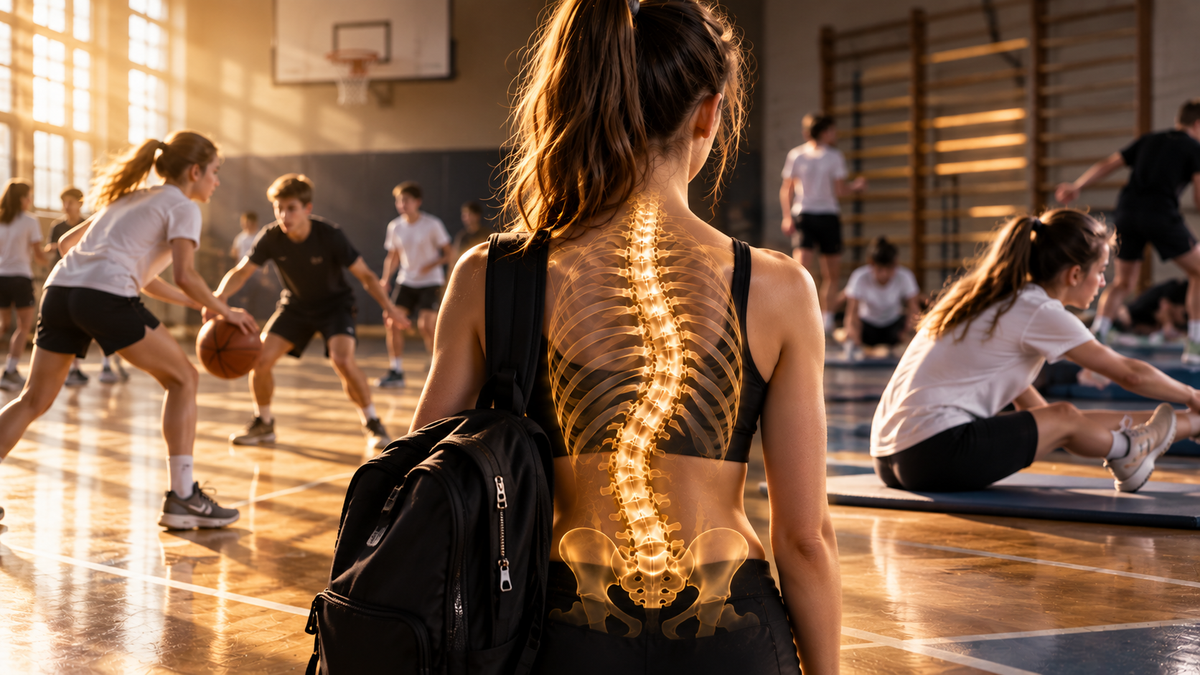
Most teenagers with scoliosis can participate in school PE.
But that does not mean school PE is treating their scoliosis.
That distinction matters.
A teenager may run, swim, play football, basketball or tennis, stretch, jump, and complete ordinary school fitness circuits.
Those activities may build general fitness, coordination, endurance, confidence, or sport-specific ability.
But they are not automatically designed around that teenager’s individual spinal rotation, muscular asymmetry, shoulder position, pelvic position, or right-to-left strength differences.
This is where many parents become confused.
They are told:
“Keep your child active.”
That is reasonable advice for many teenagers.
But staying active and receiving individualized scoliosis training are two different things.
Quick answer: Most teenagers with scoliosis can continue school PE unless their treating clinician has given specific restrictions. However, general sport and PE should not be confused with scoliosis-specific training. Football, basketball, swimming, tennis, stretching and school strength circuits do not automatically identify or address an individual teenager’s 3D rotation, muscular asymmetry, movement compensation or side-to-side strength differences.

That is why SpineX™ separates two questions:
Can the teenager participate in ordinary physical activity?
and:
What individualized training does this teenager actually need?
Medical note: This article is educational. Activity restrictions, brace instructions, post-operative return to exercise and medical clearance should come from the appropriate treating healthcare professional. SpineX™ provides fitness-based assessment and personalized exercise programming.
Table of Contents
- Can a Teenager With Scoliosis Participate in School PE?
- Why Sport Is Not a Scoliosis Treatment
- Swimming and Scoliosis
- Football and Basketball
- Tennis and Rotational Sports
- Why Generic Stretching Is Not Personalization
- Jumping, Impact and Dynamic PE Activities
- School Strength Circuits vs SpineX™ Training
- Why General Activity May Reinforce Existing Movement Patterns
- School PE While Wearing a Scoliosis Brace
- What If PE Causes Pain or Fatigue?
- Should a Teenager Be Exempt From PE?
- What Should Parents Tell the School?
- How SpineX™ Approaches PE and Sport
- When an Individualized Assessment Makes Sense
- Frequently Asked Questions
Can a Teenager With Scoliosis Participate in School PE?
In many cases, yes.
Current conservative scoliosis guidance supports continuing physical education and general sports during treatment when medically appropriate.
Restrictions may be needed in some cases depending on:
- Curve severity
- Documented progression
- Symptoms
- Brace treatment
- Recent surgery
- Medical restrictions
- The specific sport or activity
So scoliosis itself should not automatically remove a teenager from PE.
But this is where SpineX™ makes an important distinction.
PE participation and scoliosis correction are not the same goal.
School PE is designed for a group.
SpineX™ Training is designed for one individual.
A PE teacher may manage twenty or thirty students at the same time.
That teacher cannot usually assess:
- Which side of one student is functionally weaker
- How that student’s trunk rotates
- How their pelvis shifts
- How their shoulders compensate
- Whether the thoracic and lumbar regions need different training strategies
- How much extra volume one side may require
That is not the purpose of school PE.
It is the purpose of individualized scoliosis training.
Why Sport Is Not a Scoliosis Treatment
This is one of the most important points for parents.
Sport should not be prescribed as a treatment for idiopathic scoliosis.
General sport can still be useful.
It can support:
- Cardiovascular fitness
- Coordination
- General strength
- Motor development
- Confidence
- Social participation
But those benefits do not mean a sport is correcting the teenager’s individual scoliosis pattern.
A football match does not assess muscular imbalance.
A swimming session does not determine which side should receive more resistance.
A tennis lesson does not evaluate whether repeated trunk rotation is interacting with an existing asymmetry.
A school stretching routine does not identify whether one side actually needs more mobility.
A basketball session does not prescribe different loading to the left and right trunk.
This is why SpineX™ does not tell families:
“Just keep them active and that will address the scoliosis.”
Activity and individualized correction are different.
Swimming and Scoliosis
Swimming is commonly recommended because it is low-impact and provides whole-body conditioning.
But swimming is not automatically scoliosis-specific training.
Most swimming strokes involve repeated bilateral movement patterns.
That means both sides repeatedly participate in a similar general task.
If a teenager already has meaningful asymmetry in strength, muscular development or control, swimming alone does not tell us:
- Which side needs additional strengthening
- Which side already dominates the movement
- Whether one shoulder compensates
- How the rib cage rotates
- Whether one side needs more or less training volume
This is the limitation.
A teenager may become fitter from swimming.
But they can still retain the same underlying strength imbalance.
In some individuals, the already dominant side may continue contributing strongly during repeated bilateral activity.
That is why SpineX™ does not use swimming as a substitute for individualized strength training.
Swimming can be activity. SpineX™ is assessment-driven training.

Football and Basketball
Football and basketball are highly dynamic activities.
They involve:
- Running
- Acceleration
- Deceleration
- Jumping
- Landing
- Rapid directional changes
- Reactive trunk movement
These demands can be valuable for general athletic development.
But they are not designed to correct scoliosis asymmetry.
A teenager may repeatedly move through the same compensations they already use.
For example:
- One shoulder may elevate under effort
- The pelvis may shift toward the same side
- One side may consistently control landing better
- The trunk may rotate in a habitual pattern
Again, this does not mean football or basketball automatically worsens scoliosis.
It means the sport itself does not identify or correct the imbalance.
That is why a teenager can participate in sport and still need separate individualized training.
Tennis and Rotational Sports
Tennis is different from swimming because it is not symmetrical.
It involves substantial unilateral loading and repeated trunk rotation.
The serving arm, forehand, backhand, stance and rotational mechanics can all create repeated sport-specific patterns.
For a teenager with scoliosis, SpineX™ asks:
- Which direction does the trunk already prefer to rotate?
- Which shoulder dominates?
- Does the pelvis compensate?
- Which side produces more strength?
- Does the sport repeatedly load an existing dominant pattern?
That does not mean tennis must automatically be stopped.
It means the sport should be considered when the personalized training plan is built.
The sport develops tennis performance.
SpineX™ addresses the assessed imbalance around that sport.
Why Generic Stretching Is Not Personalization
Stretching is often treated as harmless and universally useful.
But scoliosis is not simply a flexibility problem.
And both sides should not automatically receive the same stretch.
Likewise, you should not assume:
“The concave side is always tight.”
or:
“The convex side always needs stretching.”
Individual mobility patterns vary.
One teenager may have restricted movement in one direction.
Another may already have excessive mobility and poor control.
This is why SpineX™ assesses movement before prescribing mobility work.
The sequence is:
Assess first. Prescribe second.
Jumping, Impact and Dynamic PE Activities
School PE often includes jumping, sprinting, relay races, plyometric drills and dynamic games.
These activities are not automatically inappropriate for every teenager with scoliosis.
But they create repeated loading and impact.
The important questions are:
- Does the teenager tolerate the activity?
- Can they control the landing?
- Do they repeatedly shift to one side?
- Does fatigue increase compensation?
- Are there symptoms?
- Are there medical restrictions?
A teenager who repeatedly collapses into the same movement pattern under fatigue may need more individualized strength and control work.
The goal is not to fear every jump.
The goal is to identify whether the teenager has the physical capacity to manage that demand well.
School Strength Circuits vs SpineX™ Training
This is where the difference becomes very clear.
A typical school circuit may ask every student to perform the same:
- Exercise
- Repetitions
- Sets
- Time interval
That is general physical education.
SpineX™ works differently.
Before prescribing unilateral training, we assess:
- Right-to-left strength differences
- Movement control
- Visible muscular development
- Shoulder compensation
- Pelvic position
- Trunk rotation
- Exercise technique
If the assessment shows that one side needs additional work, training can then be distributed differently.
That may involve individualized use of movements such as:
- Unilateral lat pulldown
- Unilateral seated lat row
- Unilateral leg extension
- Unilateral hamstring curl
- Side plank
- Elbow plank
- Dead bug
But the exercise name alone is not the treatment.
The personalization comes from:
- Which side works
- How much resistance is used
- How many sets are prescribed
- How many repetitions are performed
- How technique is controlled
- When the exercise is progressed
This is why SpineX™ says:
School PE trains the class. SpineX™ trains the individual.

Why General Activity May Reinforce Existing Movement Patterns
A teenager does not suddenly stop using their existing movement habits when they enter a swimming pool, football pitch or school gym.
They bring those habits with them.
If one side already dominates a movement, the teenager may continue using that pattern during general activity.
If the pelvis consistently shifts one way, the same strategy may appear during running or jumping.
If one shoulder consistently elevates under effort, it may remain visible during sport.
This does not mean every general activity is harmful.
It means general activity is not automatically correcting the asymmetry.
That is the SpineX™ distinction.
Activity uses the body you already have.
Individualized training attempts to change specific trainable qualities within that body.
This is why assessment matters.
School PE While Wearing a Scoliosis Brace
A teenager who wears a prescribed scoliosis brace may still participate in physical activity, depending on their medical instructions.
Some activities may be performed with the brace removed.
Other circumstances may require different guidance.
Parents should not independently alter the prescribed brace wear schedule because of PE.
Instead, confirm with the treating team:
- Whether the brace should be removed for PE
- Which activities are appropriate
- How PE fits into the prescribed wear schedule
- Whether contact or highly dynamic activities require modification
General sport and bracing can coexist.
But the brace still addresses a different goal from individualized strength training.
Our Scoliosis Brace vs Exercise guide explains this distinction in more detail.
What If PE Causes Pain or Fatigue?
Not every episode of soreness means the scoliosis has progressed.
Teenagers can experience ordinary muscular fatigue from exercise.
But repeated or worsening symptoms should not simply be ignored.
Parents should note:
- Which activity causes the problem
- Where the discomfort occurs
- Whether it happens during or after PE
- Whether it repeatedly occurs on the same side
- Whether movement changes
- How long symptoms last
If pain is persistent, severe, unusual or worsening, seek appropriate medical evaluation.
New significant weakness, numbness, major walking changes, or bowel or bladder symptoms require prompt medical attention.
Those problems should not be managed by simply changing a training plan.
Should a Teenager With Scoliosis Be Exempt From PE?
Not automatically.
For many teenagers, complete removal from PE would unnecessarily reduce physical activity.
More targeted modification may make more sense when one activity is not appropriate.
For example, a teenager may temporarily modify a high-impact activity while continuing other parts of the lesson.
After surgery or under specific medical restrictions, broader limitations may be appropriate.
Those restrictions should come from the responsible healthcare professional.
The goal should be:
maintain appropriate activity while respecting the individual medical situation.
What Should Parents Tell the School?
Parents do not need to provide the school with every detail of the teenager’s medical history.
The PE teacher needs practical information.
That may include:
- Specific medical restrictions
- Brace instructions relevant to PE
- Activities that repeatedly create symptoms
- Temporary modifications
- Post-operative restrictions
- Who to contact if a problem occurs
Our school accommodations guide explains how parents can communicate those needs without unnecessarily medicalizing the teenager’s entire school day.
How SpineX™ Approaches School PE and Sport
The SpineX™ 3D Scoliosis Method does not ask:
“Which sport is best for scoliosis?”
That question is too general.
Instead, we ask:
- What does this teenager already do each week?
- What movement patterns are visible?
- How does the trunk rotate?
- How do the shoulders behave?
- How does the pelvis shift?
- Which side demonstrates more strength or control?
- Which side fatigues first?
- What sport-specific demands are already being repeated?
We then build the training plan around the teenager rather than around a sport label.
The SpineX™ conceptual sequence is:
Decompress → De-rotate → Strengthen → Progress
If unilateral training is appropriate, one side can receive a different training stimulus from the other.
If the teenager participates in a highly rotational sport, the program can account for that.
If school PE already creates a large weekly workload, additional volume can be managed accordingly.
If strength improves, the resistance or number of sets can be progressed.
This is what general school PE cannot provide.

When Does an Individualized Assessment Make Sense?
A teenager may participate normally in school PE and still need individualized scoliosis training.
Parents often reach this point when they notice:
- A visible rib hump
- Uneven shoulders
- A consistent hip shift
- Different muscular development from side to side
- Repeated compensation during exercise
- One side appearing stronger during training
- A generic exercise plan that has never changed
- High sport participation without targeted strength work
The SpineX Surgery-Avoidance Assessment is a live one-on-one video assessment designed to evaluate the physical presentation before personalized training is prescribed.
Depending on the case, we may review:
- Available X-rays and reports
- Curve and progression history
- Current sports
- School PE demands
- Brace use
- Standing posture
- Forward bending
- Visible rotation
- Shoulder position
- Pelvic position
- Movement control
- Right-to-left physical differences
- Current exercise technique
The goal is not to stop normal activity.
The goal is to determine what ordinary activity is not addressing.
PE Keeps Your Teen Active. SpineX™ Makes the Training Individual.
Your teenager may swim, run, play football, basketball or tennis and still have meaningful right-to-left strength differences, trunk rotation or movement compensations.
General activity does not automatically correct those differences.
The SpineX Surgery-Avoidance Assessment looks at the individual before deciding which side to train, how much resistance to use, how many sets to prescribe and how the program should progress.
Frequently Asked Questions
1. Can teenagers with scoliosis participate in school PE?
In many cases, yes. Scoliosis does not automatically require exemption from physical education. Participation should reflect the teenager’s symptoms, curve severity, progression risk, brace instructions, recent surgery and any restrictions provided by the treating clinician. General physical activity can offer fitness and psychological benefits, but PE should not be confused with individualized scoliosis treatment.
2. Is swimming good for scoliosis?
Swimming can provide cardiovascular conditioning and general whole-body activity, but it is not a personalized scoliosis treatment. Most swimming strokes involve repeated bilateral movement and do not identify which side is functionally weaker or whether one side requires additional training volume. SpineX™ may allow swimming to remain part of a teenager’s activity while separately addressing assessed muscular asymmetry and strength differences.
3. Can football or basketball make scoliosis worse?
These sports should not automatically be described as causing structural scoliosis progression. They involve repeated running, jumping, directional changes and reactive movement, so individual tolerance and medical restrictions matter. The SpineX™ concern is that these sports are not designed to identify or correct a teenager’s specific asymmetries. They are sports, not individualized scoliosis training.
4. Is tennis bad for scoliosis because it is one-sided?
Tennis involves unilateral loading and repeated trunk rotation, but that does not automatically mean every teenager with scoliosis must stop playing. The better question is how the individual’s existing rotation, strength differences and compensations interact with the sport. SpineX™ can account for those demands when designing a separate personalized training strategy.
5. Should a teenager with scoliosis avoid jumping?
There is no universal rule requiring every teenager with scoliosis to avoid jumping. The activity should be considered according to symptoms, movement control, total training volume, curve severity and medical guidance. Repeated poor landing control or increasing asymmetry under fatigue can indicate a need for additional individualized strength and movement training.
6. Is stretching enough for scoliosis?
No. General stretching may improve comfort or mobility for some people, but scoliosis is not simply a flexibility problem. The two sides should not automatically receive identical stretching, and concave-versus-convex assumptions do not apply universally. Mobility work should follow individual assessment rather than a generic formula.
7. Is school PE enough exercise for a teenager with scoliosis?
School PE can provide useful general physical activity, but it is not usually designed around the individual teenager’s spinal rotation, muscular asymmetry, movement compensation or side-to-side strength differences. A teenager can be active in PE and still benefit from a separate individualized strength-training program.
8. Should a teenager with scoliosis do the same strength exercises as classmates?
Not necessarily. Some general exercises may be appropriate, but identical resistance, sets and repetitions do not account for individual strength differences or movement compensations. SpineX™ assesses the teenager before deciding whether unilateral exercise, different training volume or specific technique changes are appropriate.
9. Can a teenager with a brace still participate in PE?
Often, yes, depending on the prescribed brace, activity and instructions from the treating team. Parents should not independently change the prescribed wear schedule. The responsible clinician or orthotist should clarify whether the brace can be removed for specific activities and whether any sports require modification.
10. What is the difference between school PE and SpineX™ Training?
School PE is general physical activity designed for a class. SpineX™ Training is built around the individual. Assessment can consider curve information, rotation, muscular asymmetry, shoulder and pelvic position, right-to-left strength differences, sports exposure, technique and training capacity. Exercise side, resistance, sets and progression can then be personalized according to those findings.
Conclusion
At SpineX, we don't prescribe the same exercises for every person with scoliosis. The SpineX™ Method is a proprietary fitness-based scoliosis training system built on unilateral strength training, 3D de-rotation principles, individualized assessment, and fully personalized, progressive exercise programming. Every scoliosis is different, which is why each person's curve pattern, muscle imbalances, movement limitations, and goals require an individualized approach.
If you've made it this far, you're probably not just curious — you're looking for something that actually applies to you, or to your child, instead of another generic list that never quite fits. That's exactly what an individualized assessment is for. You don't need to guess, and you don't need to keep training blind. The SpineX Surgery-Avoidance Assessment is a live, one-on-one video call from wherever you are — no equipment, no clinic visit, just simple movement checks like bending forward and rotating side to side, so we can actually see how your body moves before recommending anything. Book your Surgery-Avoidance Assessment and finally get answers built around your spine, not a generic formula. You can also explore the SpineX™ 3D Scoliosis Method to see how a personalized program comes together once your assessment is complete.
About the Author
Kamil, founder of SpineX™
Kamil is the founder of SpineX and creator of The SpineX™ 3D Scoliosis Method — a proprietary fitness-based scoliosis training system. His methodology combines unilateral strength training, 3D de-rotation principles, individualized assessment, and fully personalized, progressive exercise programming to help people with scoliosis improve movement quality, build strength, address muscle imbalances, reduce three-dimensional spinal asymmetries, and support long-term spinal health through non-surgical management.
Through SpineX, Kamil has worked with clients worldwide, providing personalized online coaching, educational resources, and evidence-informed exercise strategies for scoliosis, kyphosis, posture, and spinal asymmetries.
Evidence and Trusted Sources
- 2016 SOSORT Guidelines for Idiopathic Scoliosis During Growth — recommends continued general sports and school physical education where appropriate, while explicitly stating that sport should not be prescribed as treatment for idiopathic scoliosis.
- 2011 SOSORT Guidelines — supports continuation of school physical education and general sport while allowing activity-specific restrictions according to curve severity, progression and specialist guidance.
- SpineX — Scoliosis School Accommodations — explains how parents can coordinate practical school support while keeping medical decisions and individualized training separate.
This article is for educational purposes only and does not provide medical diagnosis or individualized medical advice. General sports and school PE should not be treated as scoliosis-specific treatment. Activity restrictions, brace instructions, medical clearance and post-operative return to sport should be directed by the appropriate treating healthcare professional. SpineX™ Training does not guarantee Cobb-angle reduction, structural correction, prevention of progression or avoidance of surgery.