
Scoliosis Brace vs. Exercise: Does Your Child Need One or Both?
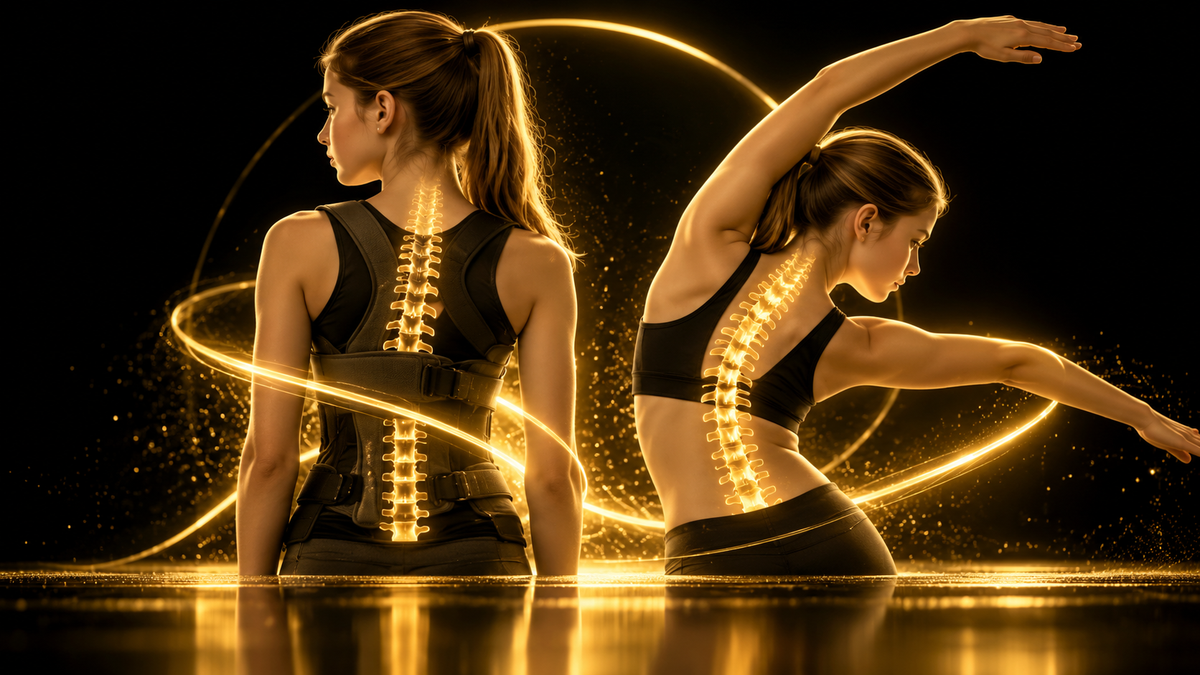
Brace or exercise—which one does your child actually need?
For parents of teenagers with scoliosis, this can become one of the most confusing treatment decisions.
A doctor may recommend a brace because the curve is progressing during growth. At the same time, you may be wondering whether your teenager should also be strengthening their body, addressing visible asymmetries, improving movement, and doing something active rather than relying entirely on an external device.
This often creates the wrong question:
“Should we choose the brace or exercise?”
For many appropriately selected teenagers, it does not have to be one versus the other.
A medically prescribed scoliosis brace and individualized SpineX™ Training are designed to address different parts of the problem. A brace is primarily used to help manage the risk of curve progression while a teenager is growing. SpineX™ Training focuses on the active physical-development side: movement, strength, assessed muscular asymmetries, three-dimensional control, physical capacity, and progressive exercise.
That means the more useful question is:
“What is the brace addressing, what is training addressing, and does my teenager need both?”
Quick answer: A scoliosis brace and individualized exercise are not automatically competing treatments. For appropriately selected growing teenagers, a prescribed brace may help manage progression risk, while personalized SpineX™ Training may address strength, movement quality, physical capacity, muscular asymmetries, and three-dimensional movement. Exercise should not automatically replace a medically indicated brace, and wearing a brace does not eliminate the potential value of individualized physical training.
 Medical note: This article is educational and does not replace advice from your child's orthopedic specialist, physician, or orthotist. Never discontinue, reduce, or modify prescribed brace wear based solely on online information or an exercise program.
Table of Contents
- Scoliosis Brace vs. Exercise: What Is the Difference?
- What Does a Scoliosis Brace Actually Do?
- What Does SpineX™ Training Address?
- Can a Brace and SpineX™ Training Be Used Together?
- Is Wearing a Brace Alone Enough?
- Can Exercise Replace a Scoliosis Brace?
- Which Teenagers May Need Both?
- How Does Training Work While a Teenager Is Bracing?
- Why Cobb Angle Alone Cannot Design the Training Plan
- What If Your Child Is Bracing but the Curve Still Progresses?
- How SpineX™ Fits Alongside Prescribed Bracing
- How to Know What Your Child Actually Needs
- Frequently Asked Questions
Scoliosis Brace vs. Exercise: What Is the Difference?
The first thing parents need to understand is that a brace and an exercise program are not simply two different ways of accomplishing exactly the same thing.
They can have different roles.
| Question | Medically Prescribed Brace | SpineX™ Training |
|---|---|---|
| Primary purpose | Help reduce progression risk during growth in appropriately selected teenagers | Develop strength, movement control, physical capacity, and address assessed asymmetries |
| Type of intervention | External mechanical support | Active, personalized physical training |
| Progressively strengthens muscles? | No | Yes, according to individual assessment and progression |
| Designed around movement assessment? | Brace design is based primarily on medical and orthotic evaluation | Yes, movement, visible rotation, strength differences, posture, and other physical findings are assessed |
| Can replace medical monitoring? | No | No |
| Can they be used together? | Yes | Yes |
This distinction immediately changes how parents should think about the decision.
If a specialist believes your child meets the medical indications for a brace, beginning SpineX™ Training does not automatically make that brace unnecessary.
Likewise, wearing a brace does not mean the teenager's physical development should automatically become passive.
SpineX™ treats these as potentially complementary tracks rather than opposing choices.
What Does a Scoliosis Brace Actually Do?
A scoliosis brace is generally prescribed during growth when a specialist believes the curve has a meaningful risk of progression and falls within an appropriate bracing range.
If you want a broader explanation of brace indications and monitoring, you can also explore the SpineX™ Bracing FAQ.
The primary medical goal of bracing is usually progression control during skeletal growth.
That is an important job.
A brace applies external corrective forces to the trunk according to the brace design and the individual's curve presentation.
Its purpose should not be confused with progressive exercise.
A brace does not progressively increase muscular strength in the way resistance training does.
It does not independently teach a teenager how to control increasingly challenging movements.
It does not progressively increase training tolerance.
And it does not replace the teenager's need to remain physically active when appropriate.
None of those points mean the brace is unimportant.
They simply show why a brace and physical training answer different questions.
Bracing Is Not the Enemy of SpineX™ Training
SpineX™ does not position medically prescribed bracing as something families need to fight against.
If a teenager meets appropriate medical criteria for bracing, the brace may play an important role in the overall conservative plan.
The SpineX™ question is different:
What is happening physically while that teenager is wearing the brace for months or years?
How are they moving?
How strong are they becoming?
Are meaningful right-to-left strength differences present?
What visible rotation or trunk asymmetry can be identified?
How is their physical capacity developing?
And is their exercise program changing as their body grows?
Those are areas where individualized training becomes relevant.

What Does SpineX™ Training Address?
The SpineX™ 3D Scoliosis Method is a proprietary fitness-based scoliosis training system built around individualized assessment, unilateral strength training where appropriate, 3D de-rotation principles, and fully personalized progressive exercise programming.
The starting point is not:
“Your child has scoliosis, so give them the standard scoliosis workout.”
The starting point is assessment.
Depending on the individual, SpineX™ may evaluate factors such as:
- Visible trunk asymmetry
- Rib-cage prominence and rotation
- Shoulder positioning
- Pelvic positioning
- Movement quality
- Right-to-left movement differences
- Strength-related differences
- Mobility limitations
- Current exercise capacity
- Sports participation
- Brace use
- Previous treatment
- Available imaging and progression history
These findings help determine how training should be constructed.
One teenager may require greater emphasis in one area.
Another teenager with a similar Cobb angle may present completely differently.
This is why SpineX™ does not prescribe exercises from Cobb angle alone.
Can a Brace and SpineX™ Training Be Used Together?
Yes.
In many cases, this is the most important concept for parents to understand.
The brace and SpineX™ Training can operate alongside one another because they address different needs.
Brace + SpineX™ Training
The brace: helps manage structural progression risk during growth when medically indicated.
SpineX™ Training: addresses the active physical-development side through individualized movement assessment, strength training, 3D de-rotation principles, muscular asymmetry assessment, and progressive programming.
They do not have to work against each other.
This creates two parallel tracks.
On the medical side, the treating team monitors the curve, growth, Cobb angle, brace fit, wear schedule, and progression.
On the SpineX™ side, the teenager's physical presentation is assessed and training is progressively developed according to how the individual moves and responds.
The overall picture becomes stronger when these tracks remain coordinated rather than pretending one makes the other irrelevant.
Our guide to non-surgical adolescent idiopathic scoliosis management explains how different conservative components can fit into a broader strategy.
Is Wearing a Brace Alone Enough?
It depends on what you mean by “enough.”
If the question is whether bracing can play an important role in managing progression risk during growth, the answer is yes for appropriately selected adolescents.
But if the question is whether the brace develops every physical quality the teenager may need, the answer is different.
A teenager is still developing physically while wearing the brace.
They are growing.
They are gaining or losing strength.
They are moving every day.
They may be participating in sports.
Their movement strategies can change.
Their posture may change.
Their physical capacity can improve or decline.
Those qualities deserve attention independent of the brace itself.
That is why SpineX™ views appropriate training during the bracing period as a potentially valuable complement rather than something that should automatically wait until bracing ends.
The months between X-rays are still months of adolescent physical development.
They can be used constructively.
Can Exercise Replace a Scoliosis Brace?
Not automatically.
This is where families should be careful with online claims.
If an orthopedic specialist has prescribed a brace because the teenager has a meaningful progression risk during growth, an exercise professional should not casually tell the family to stop using it.
Exercise and bracing have different mechanisms and different objectives.
SpineX™ Training may address:
- Strength
- Assessed muscular asymmetry
- Movement quality
- 3D movement control
- Physical capacity
- Progressive training development
Those are valuable targets.
But they do not automatically erase the medical reason the brace was prescribed.
If your child's curve, growth status, or progression changes significantly, brace decisions should be reviewed with the healthcare professional managing the brace.
The SpineX™ approach is not:
Brace OR training.
It is:
Determine what the teenager medically needs, then determine what they physically need.

Which Teenagers May Need Both a Brace and SpineX™ Training?
There is no single Cobb angle at which SpineX™ can say every teenager needs exactly the same combination.
The brace decision belongs within appropriate medical assessment.
The training decision also requires individualized assessment.
A teenager may be particularly relevant for a combined discussion when:
- A brace has already been medically prescribed
- The teenager is still growing
- The family wants to maintain or develop physical strength during bracing
- Visible trunk or rib-cage asymmetry remains present
- The teenager has noticeable right-to-left movement differences
- The current exercise plan is generic
- The training program has not been progressively updated
- The teenager participates in sport and needs an appropriate physical-development strategy
- Previous physical therapy or exercise has produced limited results
- The family wants a more individualized understanding of movement and muscular asymmetry
None of these factors automatically determines the medical treatment plan.
They simply explain why a teenager wearing a brace may still have physical needs that deserve individual assessment.
How Does Training Work While a Teenager Is Bracing?
This is another common source of confusion.
Parents sometimes assume that if the teenager wears a brace for many hours per day, they cannot train properly.
That is not necessarily the case.
The training schedule can be organized around the teenager's prescribed brace schedule, daily routine, school, sport, tolerance, and individual program.
SpineX™ Training is not built around exercising inside the brace simply because the teenager has one.
Instead, the overall training plan considers the teenager's individual circumstances and how exercise fits alongside prescribed brace use.
Exactly when the brace is removed for activity, which activities are permitted, and how brace wear should be scheduled should remain consistent with the instructions of the medical and orthotic team.
SpineX™ does not independently reduce prescribed brace hours in order to create more training time.
Training Must Still Be Individualized
Even during bracing, SpineX™ does not assume that every teenager requires the same exercises.
For example, knowing only that someone has a right thoracic curve does not tell us exactly which muscle is weak, which structure is tight, how the pelvis behaves during movement, or which side should receive greater training emphasis.
The actual physical presentation needs to be assessed.
That principle remains:
Assess first. Prescribe second.
Why Cobb Angle Alone Cannot Design the Training Plan
The Cobb angle remains one of the most important measurements used in scoliosis management.
But it cannot tell you everything required to build a personalized training program.
Imagine two teenagers who both have a 30° Cobb angle.
The number may be identical.
The physical presentation may not be.
They may differ in:
- Visible rotation
- Rib prominence
- Shoulder position
- Pelvic position
- Movement strategy
- Strength differences
- Exercise history
- Sports participation
- Physical confidence
- Remaining growth
If you want to understand the measurement itself more deeply, see our Cobb Angle Explained: What Parents Need to Know guide.
The key distinction is simple:
The X-ray helps measure the structural curve.
The SpineX™ assessment helps evaluate how the individual is physically presenting and moving.
Those pieces of information can complement one another.

What If Your Child Is Bracing but the Curve Still Progresses?
This can be one of the most stressful situations for parents.
Your child may be wearing the brace for the prescribed hours.
You may be attending appointments.
You may be following the plan carefully.
Then the next X-ray shows that the Cobb angle has still increased.
That does not automatically mean that the brace was pointless.
And it does not automatically mean that another conservative strategy can guarantee progression will stop.
Instead, several questions should be reviewed.
Was the Brace Being Worn as Prescribed?
Brace effectiveness depends partly on adherence.
The treating team should review actual wear time rather than assuming it has been sufficient.
Does the Brace Still Fit Properly?
Teenagers grow quickly.
A brace that was fitted previously may need professional review as the body changes.
How Much Growth Remains?
Progression risk is closely connected with growth.
A teenager in a rapid growth period may require particularly careful monitoring.
How Quickly Has the Curve Progressed?
One current measurement is less informative than the progression pattern across multiple comparable X-rays.
What Is Happening Physically Outside the Brace?
This is where a SpineX™ assessment adds a different layer of information.
It can evaluate movement, visible rotation, muscular asymmetry, strength-related findings, physical capacity, and the current exercise strategy.
That information does not replace the brace review.
It complements it.

How SpineX™ Fits Alongside Prescribed Bracing
SpineX™ focuses on what a personalized training system can actively develop while medical monitoring and bracing continue where appropriate.
The SpineX™ 3D Scoliosis Method follows the conceptual sequence:
Decompress → De-rotate → Strengthen → Progress
Decompress
The program may use appropriate positions and exercises intended to reduce unnecessary spinal loading and create a more favorable starting position for training.
De-rotate
Scoliosis is three-dimensional.
The SpineX™ assessment therefore considers visible trunk and rib-cage rotation rather than treating the condition only as a sideways curve on an X-ray.
Strengthen
Where the assessment identifies meaningful right-to-left differences, unilateral strength training may allow each side to be trained more precisely.
This is not based on a universal formula such as automatically strengthening whichever side is described as concave or convex.
The actual presentation is assessed first.
Progress
Strength training needs progression.
As the teenager becomes stronger and their presentation changes, the program may need to change as well.
Exercise selection, resistance, repetitions, range of motion, and emphasis can be adjusted according to reassessment findings.
This is one reason SpineX™ does not treat a teenager's first exercise plan as something that should remain unchanged indefinitely.
The teenager changes.
The training should respond.
How Do You Know Whether Your Child Needs a Brace, SpineX™ Training, or Both?
Separate the decision into two questions.
Question one: Does my child medically need a brace?
That decision should be made with the appropriate healthcare professional using information such as Cobb angle, remaining growth, skeletal maturity, previous progression, and the complete clinical situation.
Question two: What should my child be doing physically while the scoliosis is being monitored or braced?
That is where the SpineX Surgery-Avoidance Assessment becomes relevant.
The live online assessment is designed to look beyond the Cobb-angle number and evaluate the teenager's physical presentation.
Depending on the case, the assessment may review:
- Available X-rays and radiology reports
- Curve progression history
- Current brace use
- Visible posture
- Forward-bending presentation
- Visible rib and trunk rotation
- Pelvic positioning
- Movement quality
- Right-to-left movement differences
- Strength-related findings
- Previous therapy or exercise
- Sports participation
- Current training capacity
The objective is not to tell every family:
“Stop the brace and exercise instead.”
That is not the SpineX™ position.
The objective is to determine whether a personalized physical-training strategy should be developed alongside the medical plan.
The Brace and SpineX™ Training Can Work Together
If your teenager has been prescribed a scoliosis brace, you do not necessarily have to choose between protecting the curve during growth and actively developing the body.
The medical team can continue managing imaging, progression, brace fit, and prescribed wear time.
SpineX™ can evaluate movement, visible rotation, muscular asymmetries, strength-related differences, and the teenager's current physical development to determine whether personalized training is appropriate.
The SpineX Surgery-Avoidance Assessment is a live one-on-one video assessment completed from home. No gym or special equipment is required for the assessment itself.
Frequently Asked Questions
1. Is a scoliosis brace better than exercise?
They should not automatically be compared as though they perform the same job. A medically prescribed scoliosis brace is generally intended to help reduce progression risk during growth in appropriately selected adolescents. Personalized SpineX™ Training focuses on active physical qualities such as strength, movement control, muscular asymmetry, physical capacity, and three-dimensional movement. Depending on the teenager's medical and physical presentation, both may have a role. If a brace has been prescribed, exercise should not automatically be used as a reason to discontinue it.
2. Can my child exercise while wearing a scoliosis brace?
Teenagers who use a scoliosis brace can often remain physically active, but the specific activity plan and when the brace should be removed should follow the instructions of the treating medical and orthotic team. SpineX™ Training can be organized around the child's prescribed brace schedule rather than competing with it. The purpose is to develop an individualized training strategy that accounts for the teenager's scoliosis, movement, strength, current brace use, daily routine, and physical capacity.
3. Does my child still need exercise if they already wear a brace?
A brace and exercise address different needs. A brace does not function as progressive resistance training, so wearing one does not automatically develop muscular strength, movement control, physical capacity, or progressively challenge the body. Appropriate individualized exercise may therefore have a complementary role. Whether a particular teenager needs a structured training program depends on their physical assessment, goals, current activity level, medical management, and individual presentation.
4. Can SpineX™ Training replace my child's scoliosis brace?
SpineX™ Training should not automatically be treated as a replacement for a medically indicated brace. If your child's orthopedic specialist has prescribed bracing because of curve magnitude, remaining growth, or progression risk, changes to that prescription should be discussed with the professional managing the brace. SpineX™ addresses the physical-training side of scoliosis management and can potentially work alongside prescribed bracing rather than against it.
5. Why combine a scoliosis brace with strength training?
The rationale is that the two interventions can target different aspects of the teenager's situation. A brace may help manage progression risk while the skeleton is growing. Individualized strength training may develop muscular capacity, movement control, and assessed right-to-left differences. The training strategy should still be personalized rather than applying the same strength program to every teenager with scoliosis.
6. What if my child's scoliosis progresses despite wearing a brace?
Continued progression should trigger review with the treating medical team. Factors such as remaining growth, brace fit, prescribed versus actual wear time, curve pattern, and progression history may need to be evaluated. A SpineX™ assessment can add a different layer by examining the teenager's movement, visible rotation, muscular asymmetries, strength-related findings, and current training strategy. That assessment complements rather than replaces medical review of the brace and curve progression.
7. Does a brace weaken the muscles?
The effect of bracing on the body is more complex than simply saying that every teenager who wears a brace will develop weak muscles. Individual activity levels, brace schedule, growth, exercise participation, and physical conditioning all matter. What is clear is that a brace itself is not progressive strength training. An individualized program can therefore focus directly on developing strength and physical capacity while medical bracing continues when indicated.
8. Is symmetrical exercise enough for a teenager wearing a scoliosis brace?
Not necessarily. General symmetrical exercise can still contribute to overall fitness, but scoliosis presentations differ substantially between individuals. Two teenagers with similar Cobb angles may demonstrate different rotational patterns, pelvic positions, strength differences, and movement strategies. SpineX™ therefore assesses the individual before deciding whether unilateral emphasis is appropriate. The direction of the spinal curve alone should not be used as a universal rule for deciding which side to strengthen.
9. How does SpineX™ decide what exercises a teenager needs?
The process begins with individualized assessment rather than a predetermined scoliosis routine. SpineX™ reviews the available history and evaluates visible posture, movement, trunk rotation, muscular asymmetries, strength-related differences, pelvic position, physical capacity, sports participation, previous treatment, and brace use where relevant. These findings help determine exercise selection, side-specific emphasis where appropriate, resistance, repetitions, range of motion, and how the program should progress over time.
10. What is the best next step if my child has been prescribed a brace?
Continue following the medical plan and clarify any brace-related questions with the professional responsible for the prescription. If you also want to understand your child's movement, visible rotation, muscular asymmetries, strength, and individualized training needs, a separate physical assessment can be useful. The SpineX Surgery-Avoidance Assessment is designed for that purpose and can help determine how personalized SpineX™ Training may fit alongside appropriate medical monitoring and prescribed bracing.
Conclusion
At SpineX, we don't prescribe the same exercises for every person with scoliosis. The SpineX™ Method is a proprietary fitness-based scoliosis training system built on unilateral strength training, 3D de-rotation principles, individualized assessment, and fully personalized, progressive exercise programming. Every scoliosis is different, which is why each person's curve pattern, muscle imbalances, movement limitations, and goals require an individualized approach.
If you've made it this far, you're probably not just curious — you're looking for something that actually applies to you, or to your child, instead of another generic list that never quite fits. That's exactly what an individualized assessment is for. You don't need to guess, and you don't need to keep training blind. The SpineX Surgery-Avoidance Assessment is a live, one-on-one video call from wherever you are — no equipment, no clinic visit, just simple movement checks like bending forward and rotating side to side, so we can actually see how your body moves before recommending anything. Book your Surgery-Avoidance Assessment and finally get answers built around your spine, not a generic formula. You can also explore the SpineX™ 3D Scoliosis Method to see how a personalized program comes together once your assessment is complete.
About the Author
Kamil, founder of SpineX™

Kamil is the founder of SpineX and creator of The SpineX™ 3D Scoliosis Method — a proprietary fitness-based scoliosis training system. His methodology combines unilateral strength training, 3D de-rotation principles, individualized assessment, and fully personalized, progressive exercise programming to help people with scoliosis improve movement quality, build strength, address muscle imbalances, reduce three-dimensional spinal asymmetries, and support long-term spinal health through non-surgical management.
Through SpineX, Kamil has worked with clients worldwide, providing personalized online coaching, educational resources, and evidence-informed exercise strategies for scoliosis, kyphosis, posture, and spinal asymmetries.
Evidence and Trusted Sources
- Scoliosis Research Society — Bracing — patient guidance on why bracing is used, typical bracing ranges, growth, and brace-wear adherence in adolescent idiopathic scoliosis.
- Brace and Exercise Combined for Adolescent Idiopathic Scoliosis — prospective research examining combined brace and targeted exercise management in growing adolescents.
- Systematic Review and Meta-Analysis of Exercise, Bracing, and Combined Conservative Treatment — research comparing targeted therapeutic exercise, bracing, and combined conservative approaches in adolescent idiopathic scoliosis.
- Cochrane Review of Therapeutic Exercise for Adolescent Idiopathic Scoliosis — evidence review examining exercise compared with observation, bracing, and other conservative management strategies.
This article is provided for educational purposes only and is not medical diagnosis or individualized medical advice. Do not discontinue, reduce, or alter a prescribed scoliosis brace without consulting the qualified healthcare professional responsible for your child's treatment. SpineX™ Training does not guarantee Cobb-angle reduction, prevention of progression, or avoidance of surgery.